The whole route
Know where the cart will stop
Departure, passage, and arrival all need an appropriate arrangement.
Independent retail-work journal · US edition
Good work starts with
a clear next step.
Practical reading for people interested in the day-to-day work of Nordstrom and the wider retail workforce. Safe task setup, useful handoffs, accessible service, and the questions that keep uncertainty from becoming an assumption.
Begin with the workday brief01 / Set up the work
A handling task includes the receiving place, the route, the repetition, and the method you are trained to use. Start there before trying to make the object move.
Read the handling guide →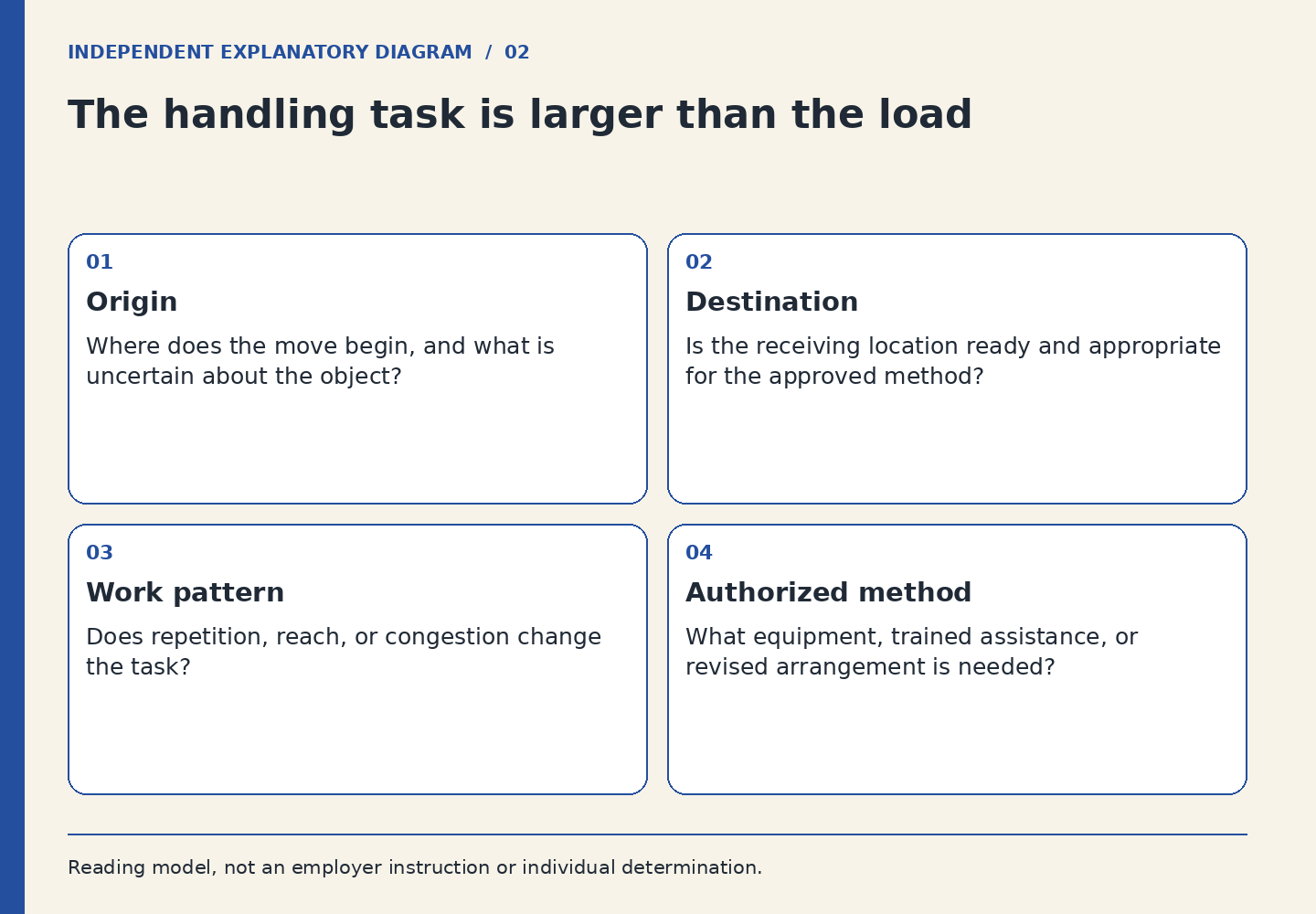
The whole route
Departure, passage, and arrival all need an appropriate arrangement.
Workload and recovery
Describe the task difficulty and ask for the appropriate review.
Before an alarm
Public advice cannot supply a building’s routes or your assigned role.
1 → 2
Completed.
Pending.
Still uncertain.
Those are different states. A useful handoff keeps them different.
03 / Serve with care
Ask which communication method works for the customer, preserve the meaningful information, and find the responsible support when the exchange needs more.
Make the conversation usable →A clear boundary
An ordinary service problem and a threatening situation need different responses. Use trained support and the actual workplace plan.
Read the service boundary →04 / Learn and improve
Purpose, decision points, stop conditions, and supervised practice.
Observed event, current exposure, response taken, and open condition.
A local discussion aid
The Next Safe Step aid helps prepare a work conversation. It never grants clearance, assesses a live hazard, or replaces the site’s training and response.
LOCAL DISCUSSION AID / NO PERSONAL INPUT
Choose a work situation and a checkpoint to prepare a question, an appropriate discussion step, and a clear boundary. This aid does not assess a live hazard, authorize work, or replace training.
Choose a situation and checkpoint. For an active emergency, use the workplace response and emergency services as appropriate.
Identify the last confirmed work state, the condition that remains uncertain, and the person authorized to resolve it. Use current workplace instructions and trained support. For immediate danger, stop the planning exercise and use the applicable emergency response and emergency services as appropriate.
Choices stay only in current page memory. No submission, personal-text input, tool storage, or URL change. Browser-managed form restoration may behave independently. External sources have their own policies. Public source review: October 7, 2026.
The reading desk
12 articles
Prepare the work
Confirm the assignment, the relevant support route, and what changed before a familiar routine becomes an assumption.
Read the article : Start a Retail Workday With Three Answers, Not a Longer ChecklistMove and set up
Look at the load, origin, destination, repetition, and available assistance before attempting a handling task.
Read the article : Before a Lift, Read the Task Around the BoxMove and set up
Plan the departure point, travel path, and destination so a cart does not simply move a hazard somewhere else.
Read the article : A Stockroom Route Includes the Place You Will StopWork together
Use five small fields to make unfinished work, current conditions, and the next responsible step visible.
Read the article : Hand Over the State of the Work, Not the Whole StoryWork together
Separate what you remember doing from what the approved record or physical task actually confirms.
Read the article : Restart an Interrupted Task From a Verified CheckpointServe with care
Distinguish a service problem from threatening behavior, use trained support, and avoid turning de-escalation into a personal obligation.
Read the article : A Difficult Customer Conversation Has a Safety BoundaryServe with care
Ask about the communication need, preserve the customer’s choices, and involve the responsible person when more support is needed.
Read the article : Accessible Service Begins With the Customer’s Preferred Way to CommunicateLearn and improve
Ask for the purpose, decision points, stop conditions, and supervised practice that make a demonstration usable.
Read the article : Learn a New Task by Showing the Decision, Not Just Repeating the MotionLearn and improve
Separate observation, immediate protection, and the unresolved condition when reporting a near miss or recurring hazard.
Read the article : Describe a Close Call So the Work Can ChangePrepare the work
Describe how fatigue or an overloaded assignment affects safe work and ask for an appropriate review of the conditions.
Read the article : When Fatigue Changes the Task, Make the Work Problem VisibleWork together
Coordinate customer coverage and unfinished tasks without promising times, outcomes, or coworker availability you cannot confirm.
Read the article : On a Busy Floor, Make the Next Promise Small and TruePrepare the work
Ask where alerts, response instructions, reporting routes, and assigned responsibilities come from at the actual worksite.
Read the article : Learn the Local Emergency Plan Before an Ordinary Day Changes